
Should School Only Prepare Students for Exams?
A common claim about education in Japan is that children do not take exams before the age of ten.
The reality is more nuanced. Japanese students are assessed throughout their education. What truly distinguishes the system is the broader importance given to the child’s overall development beyond academic knowledge alone.
Japan’s Ministry of Education presents this approach through three complementary dimensions: academic knowledge, human qualities, and physical well-being. The objective is not simply to prepare students to pass tests, but also to develop people who can live, act, and cooperate within society.
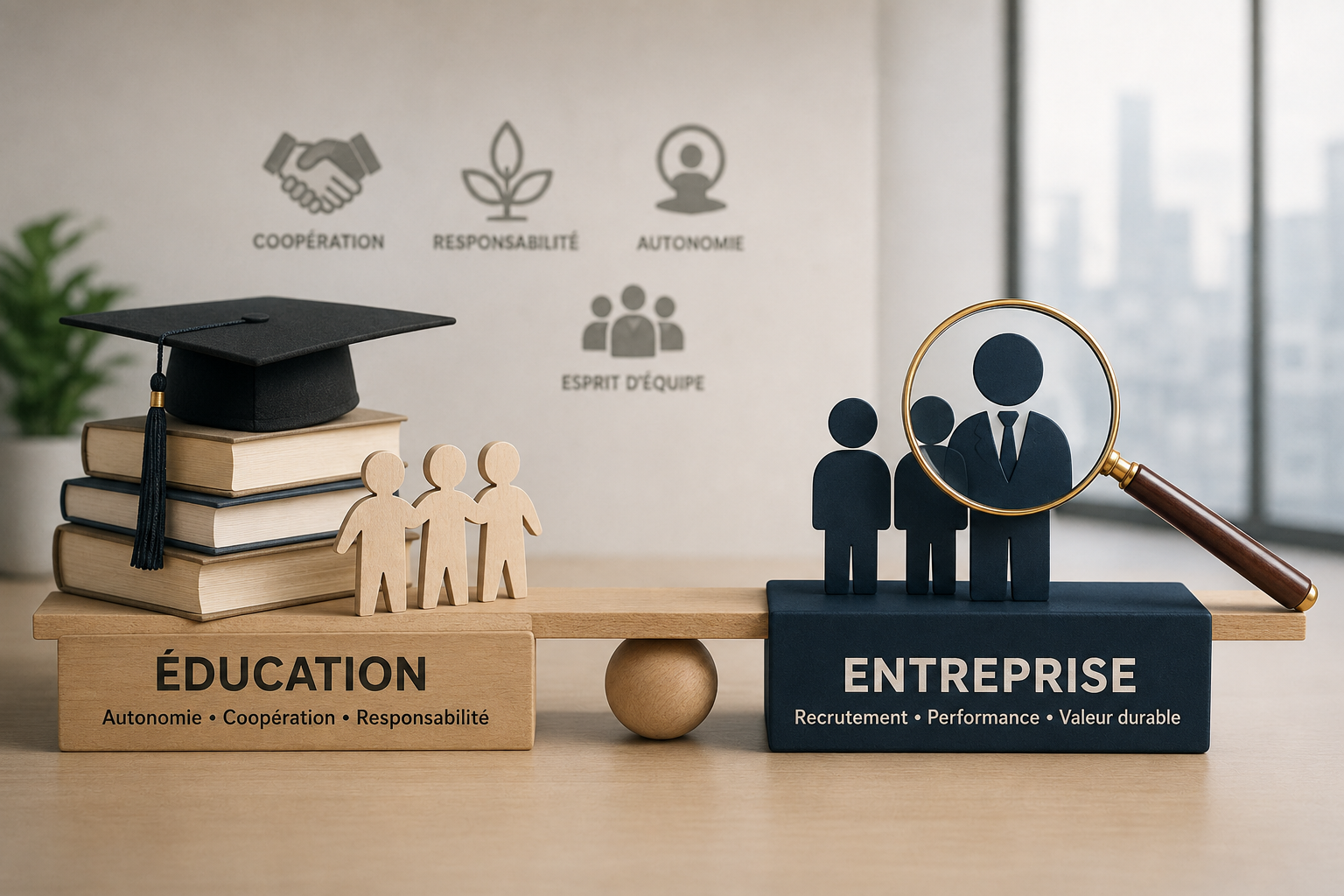
This perspective is highly relevant to employers. Many of the qualities companies expect from their employees begin to develop long before a person enters the professional world.
Responsibility Is Learned Through Practice
In most Japanese schools, time is set aside for students to clean classrooms and shared spaces together. Students are divided into groups and take responsibility for specific areas of the school.
These activities are not viewed simply as maintenance tasks. They provide opportunities to practise cooperation, respect for shared spaces, and contribution to collective life.
The value of this practice is therefore not limited to keeping a classroom clean.
It communicates a deeper principle: everyone shares responsibility for the environment they use with others.
Children learn that the success of a group does not depend only on authority. It also depends on individual participation, respect for commitments, and the ability to complete a shared task.
Responsibility becomes more than an abstract value. It becomes part of everyday experience.
School as a First Experience of Collective Life
The Japanese approach also gives importance to class activities, collective responsibilities, and participation in school life.
Through these experiences, children learn to listen, divide responsibilities, respect common rules, and resolve certain difficulties with others.
The OECD describes Japanese education as a holistic model in which academic learning is combined with social, emotional, and collective development.
School therefore becomes an early experience of society.
Students learn that they cannot always act according to their personal preferences alone. They must also consider the needs of the group, accept certain constraints, and contribute to a shared result.
These lessons are closely connected to professional life.
Human Skills Do Not Suddenly Appear at Recruitment
Companies increasingly look for people who are autonomous, responsible, adaptable, and able to work effectively with others.
However, these qualities do not suddenly emerge when someone accepts their first job.
They develop gradually through education, shared experiences, responsibilities, and the way a person learns to manage relationships with others.
When children contribute to a common task, respect a classmate’s role, or take care of a shared environment, they are already developing behaviours that will later be valuable in the workplace.
Cooperation, listening, and accountability are not simply concepts that can be explained during a corporate training session. They are strengthened through practice and repetition.
What This Approach Changes in Recruitment
For employers, this reflection is a reminder that successful recruitment cannot be based solely on qualifications, years of experience, or technical expertise.
These elements remain important, but they do not always predict whether a person will integrate successfully into an organization.
A candidate may be technically excellent while struggling to communicate, receive feedback, cooperate, or respect collective commitments.
On the other hand, a candidate with strong potential, learning agility, and a genuine sense of responsibility may progress quickly when placed in the right environment.
Recruitment should therefore seek a balance between three dimensions:
the expertise required for the role, the candidate’s potential for growth, and the way that person interacts with the wider team.
The objective is not to recruit identical personalities. It is to identify people who can bring their expertise while contributing positively to the organization.
Assessing Behaviour Without Relying on Personal Impressions
Human skills are sometimes assessed too intuitively.
A confident and outgoing candidate may quickly be described as an excellent communicator. A quieter person may be underestimated, even though they may demonstrate strong listening, cooperation, and analytical abilities.
A rigorous evaluation should therefore focus on real situations.
How did the candidate manage a disagreement?
How do they respond when priorities change?
What responsibility did they personally assume in a team project?
How do they describe their mistakes and what they learned from them?
These questions make it possible to move beyond general statements and better understand actual professional behaviour.
The Role of Management After Recruitment
Recruitment is only one part of the process.
Even highly capable employees may lose their autonomy in an organization where every decision is centralized. Cooperation can also decline when individual targets constantly compete with collective objectives.
A company that expects responsibility must provide real responsibility.
An organization that values initiative must allow room for decision-making.
A management team that wants stronger cooperation must create an environment where information sharing, mutual support, and collective contribution are genuinely recognized.
Human skills therefore depend not only on the people hired, but also on the company’s culture and operating model.
Learning Without Idealising the Model
The Japanese education system should not be presented as perfect.
The OECD has also identified challenges related to student well-being, changing educational needs, and teacher workload.
The objective is not to reproduce every Japanese practice in a different cultural context.
The real lesson is more universal: expected behaviours are not created through speeches alone. They are built through concrete responsibilities, repeated experiences, and a coherent environment.
Recruiting Expertise and the Ability to Contribute
The professional world is changing rapidly. Technical knowledge may become outdated, tools may change, and entire roles may evolve.
In this environment, the ability to learn, cooperate, adapt, and take responsibility becomes increasingly important.
Japanese education reminds us that these qualities take time to develop.
For employers, the lesson is clear: effective recruitment is not only about finding someone who can perform a role today.
It is about identifying a person who can learn, grow, and contribute sustainably to the success of the wider organization.
Are you looking for candidates who combine expertise, potential, and strong human skills? A structured recruitment and executive-search approach can help identify the talent that truly fits your organization.