
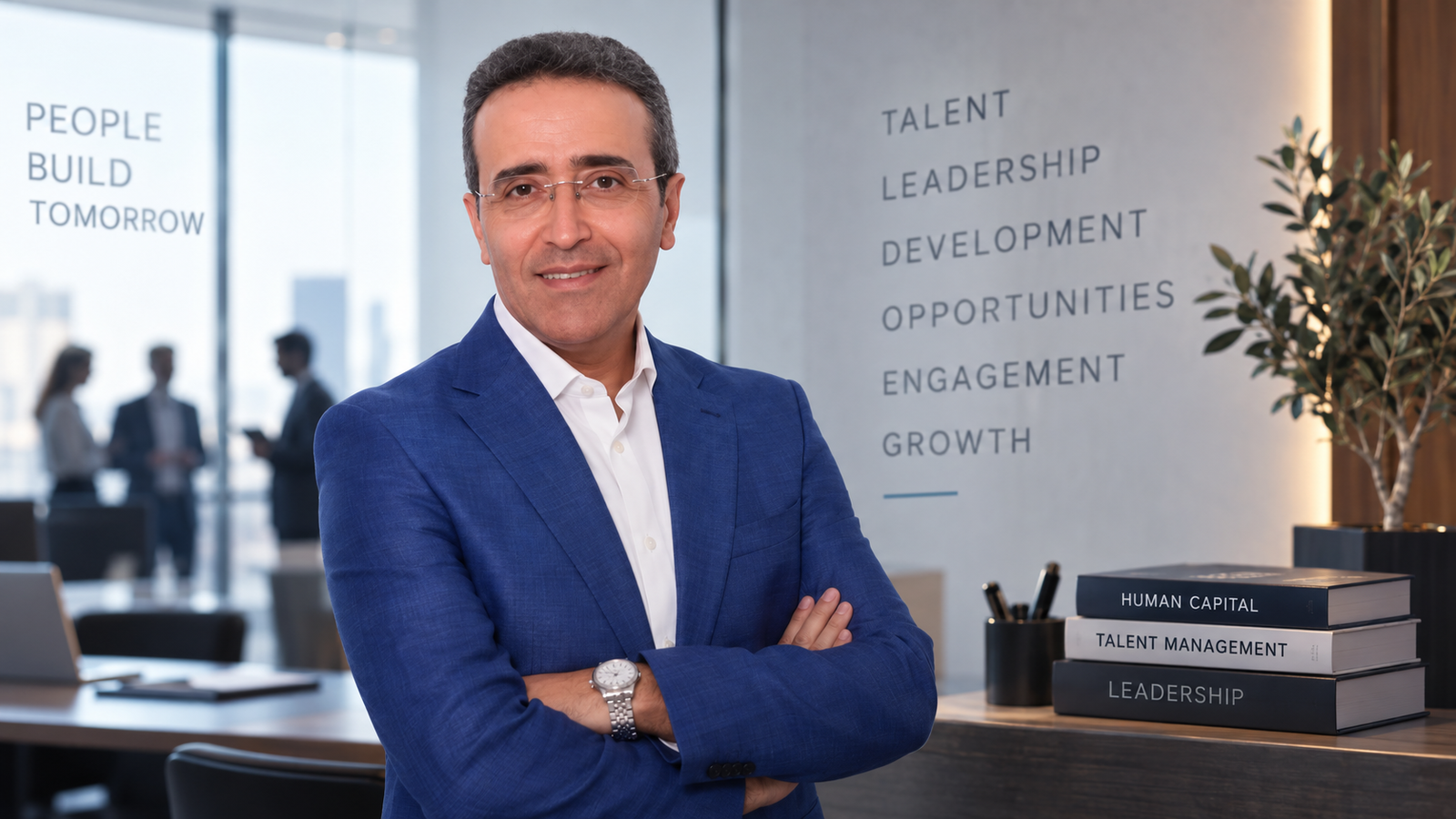
Developing talent is no longer simply about organizing training programs or preparing employees for their next promotion.
In organizations facing rapid transformation, changing roles and increasing competition for critical skills, the question has become much more strategic: how can companies create an environment in which employees can grow while directly contributing to business ambitions?
Hicham Talbi’s career, recently featured by TelQuel, provides an interesting starting point for exploring this question.
Following experience across the public, port, pharmaceutical and insurance sectors, he spent ten years leading Human Resources for Bayer across Morocco, Algeria and Tunisia. Since November 2025, he has served as Deputy General Manager in charge of Human Capital & Resources at AtlantaSanad Assurance.
Beyond an individual career path, several themes highlighted by this experience raise a broader question for executives and HR leaders: how can talent development become a genuine driver of performance?
Understand the business before deploying the tools
HR transformation is often associated with new systems, processes and technologies.
But even the most sophisticated tool cannot replace a deep understanding of the business.
The TelQuel article highlights the importance of understanding an organization’s activities, constraints and ambitions before implementing HR solutions.
This principle is fundamental.
Talent development should begin with the organization’s real needs.
Which roles are becoming strategic?
Which capabilities will be required tomorrow?
Where are the critical areas of expertise?
Which positions represent succession risks?
Which capabilities can be developed internally, and which ones will need to be sourced externally?
HR can then move beyond process management and become a genuine partner to business strategy.
Develop talent rather than simply manage positions
An organization may successfully recruit strong professionals and still struggle to retain or develop them.
Talent development therefore requires companies to look beyond the employee’s current position.
Employees need greater visibility into potential career paths, internal mobility opportunities and projects that allow them to develop new capabilities.
The experience described by TelQuel includes the implementation at Bayer of a talent marketplace, combining internal job opportunities, development projects, networking and career navigation tools.
The broader principle is valuable: making internal opportunities more visible can turn mobility into a genuine talent-development mechanism.
Retention begins before resignation
Retention of critical capabilities cannot begin when an employee announces that they are leaving.
It needs to be anticipated.
Organizations must understand what encourages talented people to stay: career opportunities, management quality, recognition, compensation, autonomy, learning opportunities and meaningful projects.
This becomes particularly important for scarce profiles and roles that are essential to organizational continuity.
An effective Human Capital strategy should therefore identify critical populations, assess retention risks and create pathways capable of sustaining engagement over time.
Managers remain central to talent development
HR policies can establish frameworks.
Digital tools can improve access to opportunities.
But an employee's daily experience is still strongly influenced by their manager.
Growing talent therefore requires better management practices.
Managers need to be able to identify potential, provide meaningful feedback, delegate, support capability development and create opportunities for progression.
Organizations may therefore need to assess managers not only on the results they produce, but also on their ability to develop the people they lead.
Human capital development becomes a shared responsibility between HR, management and executive leadership.
Artificial intelligence can support HR — not replace it
The TelQuel article also refers to the integration of artificial intelligence tools to simplify processes and support career development.
These technologies can provide genuine value when they automate repetitive administrative activities, make better use of HR data or help employees identify development opportunities.
In an earlier interview about AI at Bayer North Africa, Hicham Talbi also described its potential to reduce repetitive work and allow HR teams to focus on higher-value activities such as talent development, coaching and engagement.
Technology alone, however, cannot solve questions of organization, leadership or culture.
The fundamental question remains: what capabilities does the organization need to develop, and why?
From recruitment to development: consider the entire talent journey
Recruitment remains essential.
But identifying the right candidate is only the beginning.
A high-performing organization needs to consider the entire talent lifecycle: attracting, selecting, integrating, developing, mobilizing and retaining.
This is where Executive Search and Human Capital advisory come together.
Recruiting an executive or strategic profile only creates value when the role is clearly defined, the organization provides the conditions for success and the integration is aligned with a broader view of the capabilities required by the business.
MAK Associates supports Moroccan and international companies across both dimensions: identifying strategic profiles and structuring organizations and human capital practices.
Growing talent means growing the organization
The experience highlighted by TelQuel should not be viewed as a single model to replicate.
It does, however, illustrate a fundamental shift in the role of Human Resources.
HR is no longer simply responsible for administering people.
It increasingly contributes to creating the conditions in which skills can develop, circulate and support business strategy.
Growing talent is therefore not only about investing in individuals.
It is about building an organization capable of turning their potential into sustainable performance.
News source: TelQuel / content produced by Jankari Consulting — “Hicham Talbi, AtlantaSanad Assurance : les RH pour faire grandir les talents.”