
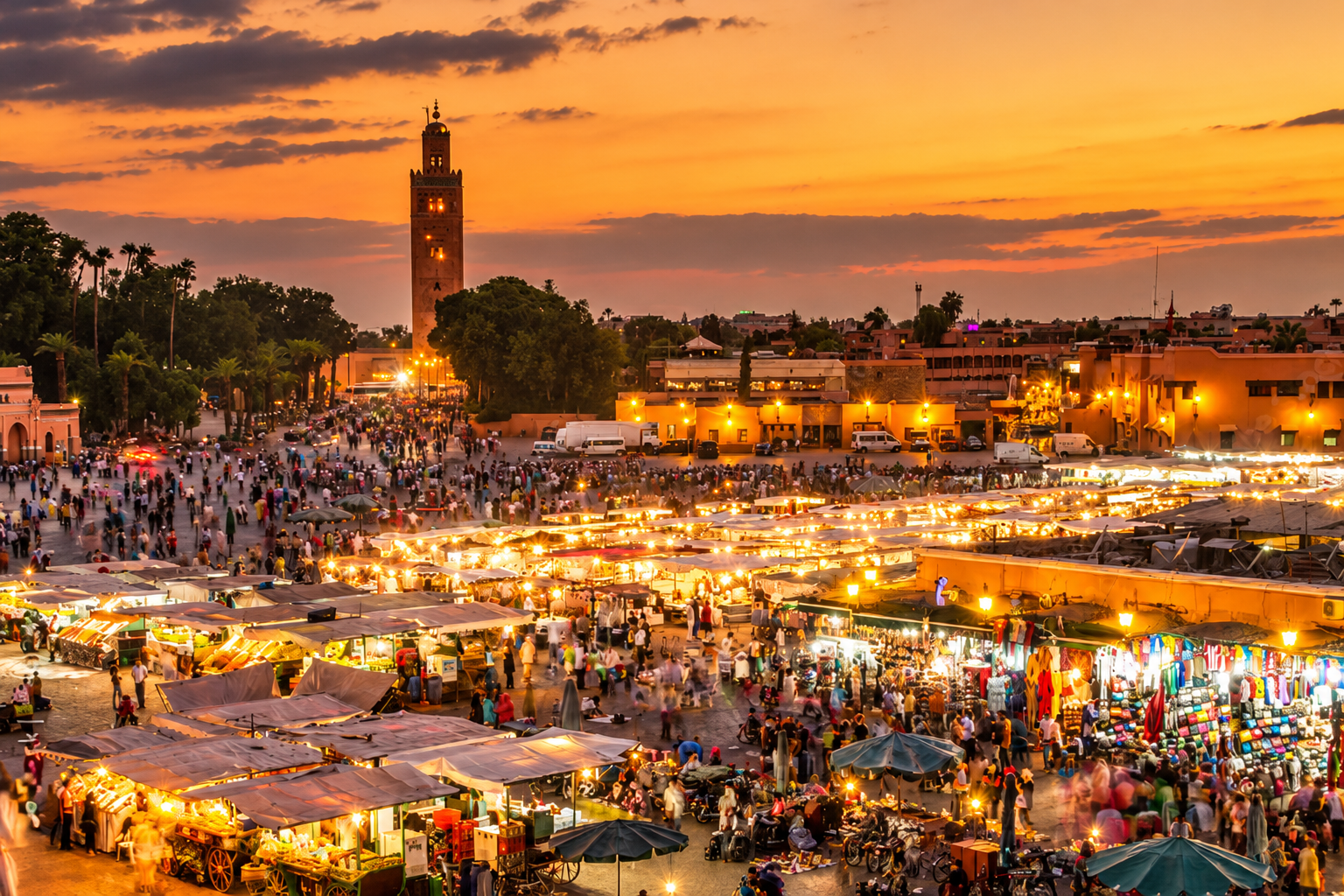
Tourism is strengthening its position within the Moroccan economy.
In 2025, tourism GDP reached MAD 129.7 billion, an increase of 11.7% compared with 2024. Its contribution to national GDP consequently increased from 7.2% to 7.5%.
Domestic tourism consumption reached MAD 222.4 billion, growing by 10.3%.
These figures reflect strong economic momentum.
But beyond growth, a more strategic question emerges:
does the sector have the investment, business models and capabilities required to turn this momentum into sustainable growth?
Tourism is becoming increasingly significant to the economy
Tourism growth is not only about increasing visitor numbers.
It is also generating more economic value.
In 2025, tourism production reached MAD 199.4 billion, up 9.6%.
Tourism value added reached MAD 106.8 billion, an increase of 10.8%.
These indicators show that tourism has become sufficiently significant for its performance to have a broader impact on the Moroccan economy.
But as a sector expands, so do its requirements.
More visitors require greater accommodation capacity, stronger services, additional investment and a greater ability to maintain the quality of the tourism experience.
Inbound tourism is a major driver
Growth in 2025 was largely supported by spending from non-resident visitors.
Inbound tourism consumption reached MAD 154 billion, increasing by 12.5%, and now represents 69.2% of total tourism consumption.
Domestic and outbound tourism consumption also increased, reaching MAD 68.4 billion.
This structure demonstrates the strategic importance of international demand to Morocco's tourism economy.
But it also raises an important financial question:
how can Morocco sustainably increase the value generated by each visitor, rather than focusing only on visitor volumes?
Tourism development therefore needs to consider average spending, length of stay, quality of supply, diversification of activities and the economic value generated around each destination.
Revenue growth is not the same as value creation
Strong activity does not automatically translate into strong profitability.
For hotels, restaurants, transport providers and tourism-service operators, growth can also create substantial additional costs.
Recruitment, wages, energy, maintenance, property investment, digitalization, marketing and equipment can all absorb part of the additional revenues generated.
The financial question is therefore no longer simply:
“Is the market growing?”
It becomes:
“Is that growth translating into sustainable value creation?”
Companies need to monitor profitability, productivity, investment capacity and the quality of their business models alongside market growth.
Investment needs to keep pace with demand
Sustained tourism demand requires additional capacity.
Accommodation, food services, mobility, infrastructure, leisure activities, technology and related services all need to develop accordingly.
This creates important opportunities for investors and operators.
But it also creates a capital-allocation challenge.
Where should investment go?
Which destinations offer the strongest opportunities?
Which segments should be prioritized?
What positioning is appropriate?
And what returns can reasonably be expected?
Growth across a market does not automatically guarantee the performance of every investment within it.
Capital therefore needs to be allocated according to actual demand, positioning and execution capacity.
Human capability is also tourism infrastructure
It is relatively easy to visualize a new hotel.
It is more difficult to rapidly build all the capabilities required to operate it at the expected standard.
A hotel is more than a building.
A restaurant is more than its location.
A tourism experience is more than its concept.
All depend on the people who operate them.
Hotel managers, operations leaders, chefs, commercial teams, revenue-management specialists, customer-experience professionals, digital functions, finance leaders and frontline teams all contribute directly to economic value.
As the sector expands, the availability of these capabilities becomes strategic.
Recruiting more people is not enough
A fast-growing sector may create increasing competition between employers for the same talent.
The challenge therefore moves beyond opening more positions.
Organizations need to attract, develop and retain the right people.
This requires attention to career development, management quality, learning, internal mobility, compensation, recognition and progression opportunities.
An organization that successfully attracts customers but continuously loses experienced employees may struggle to maintain service quality.
Retention consequently becomes an economic performance issue as well as an HR issue.
Service quality is also a financial variable
In tourism, a significant part of value depends on the experience delivered.
Property investment may be excellent.
Marketing may successfully generate demand.
But the customer experience ultimately depends on a sequence of human and operational interactions.
Welcome, responsiveness, problem solving, language capabilities, product knowledge and personalization all influence perceived quality.
Those factors can affect reputation, recommendations, online reviews and loyalty.
Human Capital should therefore not be viewed solely as a cost.
In a service economy, it contributes directly to an organization's ability to protect its positioning and revenues.
Management capability becomes critical during rapid growth
Fast-growing businesses can increase their workforce faster than their management capacity.
A strong operational employee does not automatically become an effective manager.
As teams expand, organizations need people capable of managing performance, developing employees, onboarding new recruits and protecting service standards.
Middle management therefore becomes strategically important.
For expanding operators, identifying and preparing future leaders before vacancies become urgent can directly improve execution quality.
Finance and HR need to look at the same performance picture
In service businesses, financial and people decisions are deeply connected.
Excessive workforce reductions may improve costs in the short term while damaging customer experience.
Conversely, increasing headcount without monitoring productivity may weaken margins.
Organizations therefore need to connect metrics such as:
revenue,
margin,
occupancy,
productivity,
labor cost,
turnover,
service quality,
customer satisfaction,
and future capability needs.
Finance measures performance.
Human Capital helps explain part of the capability behind that performance.
Prepare talent before the next growth cycle
The current momentum also gives tourism businesses an opportunity to anticipate future requirements.
Which roles will become harder to recruit?
Which functions need strengthening?
Which managers need to be developed?
Which expertise can be built internally?
Which profiles will need to come from the external market?
This becomes particularly important when tourism investments are planned several years ahead.
Infrastructure can be planned in advance.
Human Capital should be planned in advance as well.
Turning current growth into sustainable advantage
Morocco's 2025 tourism figures demonstrate substantial economic momentum.
The next challenge is to turn that growth into sustainable capability.
That means allocating capital intelligently.
Improving productivity.
Developing higher-value offers.
Protecting service quality.
And building the skills required to support expansion.
Growth creates opportunity.
Finance determines how capital is deployed.
Human Capital helps determine how effectively that opportunity is executed.
For tourism businesses, the challenge is no longer simply to benefit from current momentum.
It is to build the organizations capable of sustaining it.
News sources: High Commission for Planning, 2025 Tourism Satellite Account; Médias24, “Le PIB touristique bondit de 11,7% en 2025 et pèse désormais 7,5% de l’économie nationale,” October 20, 2026.