
Organizational growth does not depend only on infrastructure, network expansion, or investment.
It also depends on a company’s ability to develop the capabilities of its people, transfer know-how, and prepare employees for future responsibilities.
This is the context in which Akdital’s recent initiative should be understood.
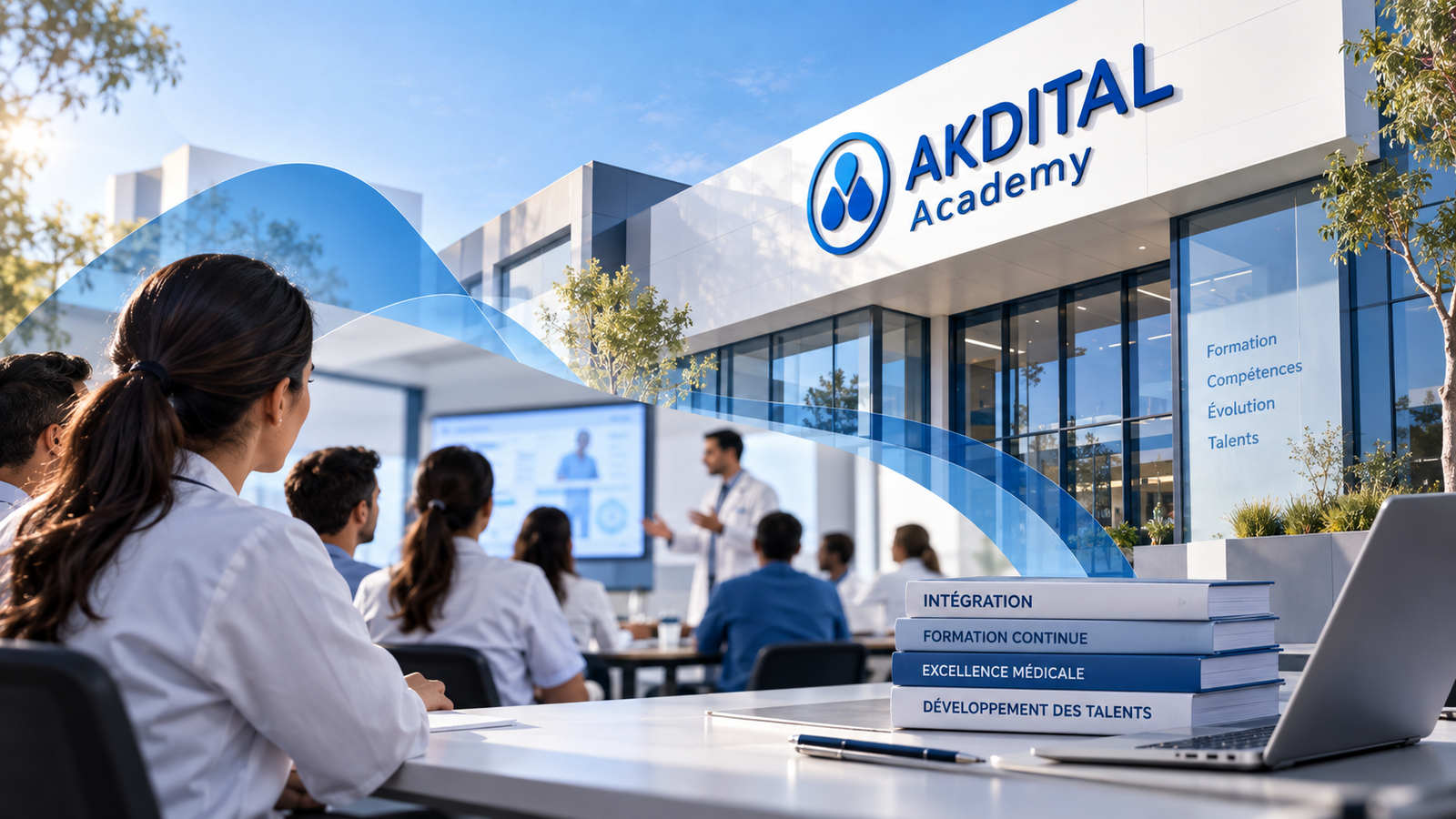
According to Médias24, the group launched Akdital Academy, an internal training system designed to support capability development, knowledge transfer, and employees’ professional growth.
Beyond the announcement itself, this initiative raises an important question for executives and HR leaders: what does an internal academy really change in the structuring of human capital?
Structuring training rather than multiplying isolated initiatives
In many organizations, training already exists.
But it can sometimes remain fragmented, occasional, or driven mainly by immediate needs.
The value of an internal academy lies precisely in bringing greater structure, continuity, and coherence.
Akdital Academy is designed to structure training throughout the employee journey, from onboarding new hires to upskilling existing teams and supporting talent expected to move into new responsibilities.
This changes the logic.
Training is no longer only a response to an immediate need.
It becomes a structured mechanism that supports the organization’s long-term growth.
Training is not only about transmitting knowledge
An effective internal learning policy is not limited to providing content.
It must also reinforce practices, secure know-how, accelerate onboarding, and prepare career development.
Akdital’s model relies on several complementary pathways covering onboarding and job preparation, continuous learning, support for professional progression, and distance learning.
The programs combine theory, simulations, field immersion, and the transfer of know-how by experienced professionals.
From an HR perspective, this is crucial.
An internal academy becomes strategic when it links learning directly to real work situations and operational needs.
Onboarding and internal mobility become structured priorities
One of the most important benefits of an internal academy is that it does not serve only established employees.
It also helps structure the onboarding of new hires and supports internal mobility.
Akdital Academy is also expected to strengthen the transmission of group culture, facilitate the integration of new recruits, and support internal mobility.
This matters especially in fast-growing organizations.
When recruitment accelerates, the ability to integrate new employees effectively becomes a direct performance issue.
Likewise, successful internal mobility requires job transitions to be prepared and supported by relevant development mechanisms.
Developing talent according to real business needs
An academy creates value only if it remains closely connected to the organization’s real needs.
The first cohort of Akdital Academy brings together around fifty employees focused on operations-related roles, with the scope expected to expand progressively to other functions and professions, including paramedical roles, depending on identified needs across the group’s facilities.
This principle is essential.
Capability development should not be designed as a generic program.
It should be built around critical roles, future capability needs, hard-to-fill positions, and upcoming transformations.
That is when training becomes a genuine strategic talent lever.
Measuring investment in capabilities
In 2025, Akdital had already deployed 462 training initiatives covering 326 topics, benefiting 2,703 participants, for a total of 41,822 training hours.
These figures show that Akdital Academy is part of a broader training policy already underway.
For organizations, this is an important reminder: an internal academy is not just a name or a communication initiative.
It requires a real investment over time in content, instructors, and the ability to connect business needs with learning pathways.
Making human capital a driver of growth
One of the most interesting dimensions of this initiative is the way it connects capability development to the group’s broader growth.
The logic behind Akdital’s initiative is clear: growth in infrastructure must be supported by an equivalent investment in skills, knowledge transfer, and future capabilities.
In healthcare, this issue is particularly important.
Quality of care depends on the expertise of teams, but also on their ability to continuously improve their practices and develop over time.
This is what gives an internal academy real strategic significance.
Training is not only about improving technical knowledge.
It is also about preparing the organization to sustain its own growth.
An internal academy is not just a training center
The main HR value of an academy is not only pedagogical.
It is also organizational.
A structure like this makes it easier to connect business needs, onboarding, upskilling, knowledge transfer, internal mobility, and preparation for future responsibilities.
In other words, training becomes a direct component of business strategy.
When an organization structures its internal training, it does not only develop capabilities. It builds the conditions for continuity, execution quality, and growth.
News source: Médias24 — “Akdital lance son academy pour structurer sa formation interne.”