
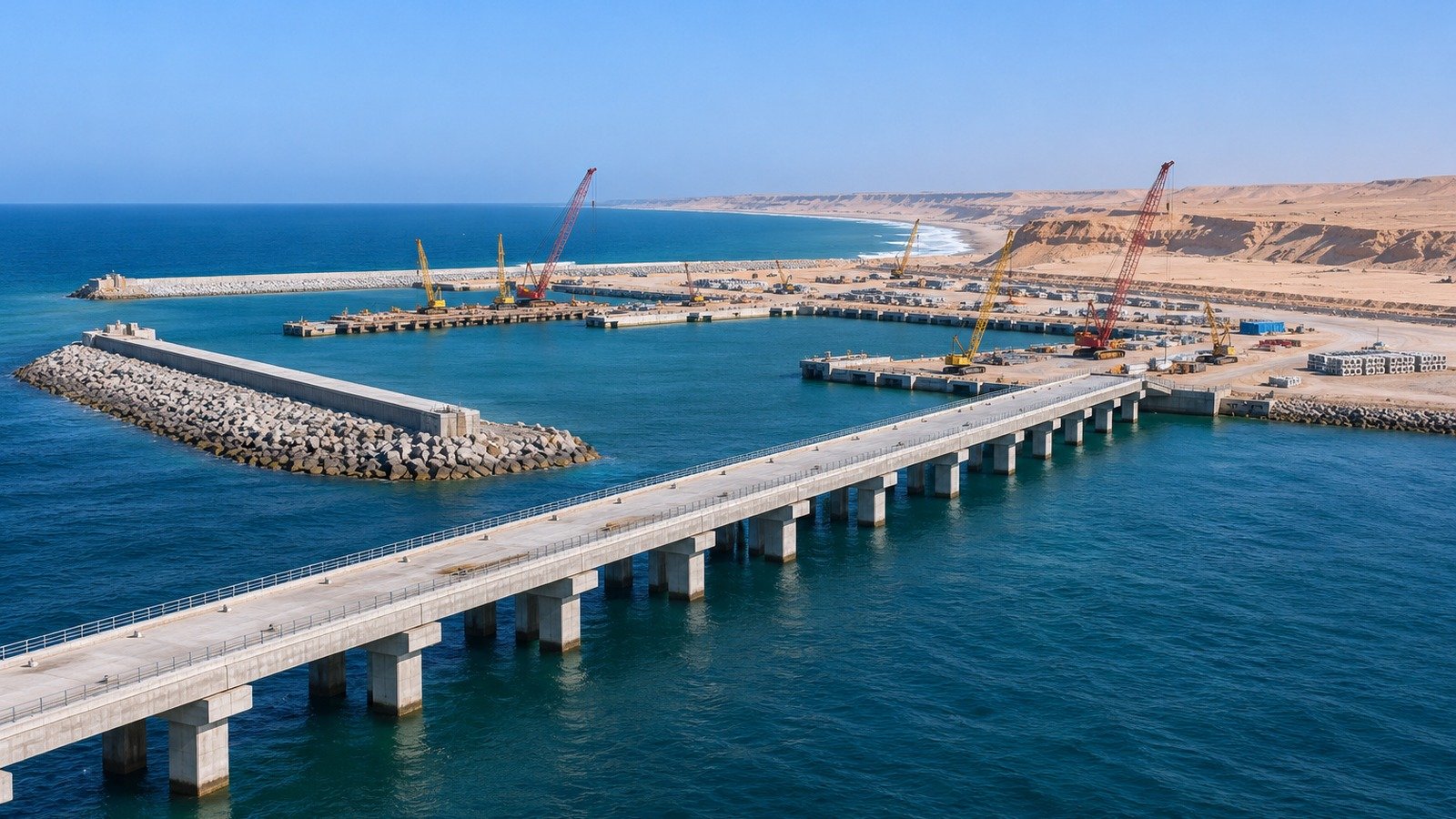
Dakhla Atlantic port: a study will compare management models for the port and its 1,650-hectare zone. Governance and financing are being decided now.
On November 10, 2026, Médias24 reported the launch of a study to define the future management model of the Dakhla Atlantic port and its industrial and logistics zone.
Construction is progressing: 65% complete in July 2026, with works due to finish at the end of 2028 and operations starting in 2029. But infrastructure of this scale is not only about concrete. It is also about how it will be managed, financed and governed.
A study to decide who will run the port, and how
The study, launched by the Directorate of Ports and Maritime Public Domain through an open international tender, must examine several options:
- joint management of the port and the industrial and logistics zone by a single entity;
- separate management by two distinct structures;
- other models the consultant may propose, including a formula combining several options.
The estimated cost of the assignment is MAD 3 million including tax. Bids are due to be opened on December 22, 2026 in Rabat.
Why the management model is first a financial question
The terms of reference are explicit: for each scenario, the consultant must specify the governance model, the responsibilities of each party and the financing arrangements.
Each model will come with a business plan detailing:
- the investments required;
- operating costs;
- forecast revenue;
- financing needs.
In other words, choosing the model is not an administrative decision. It determines who carries the investment, who collects the revenue and who bears the risk if traffic falls short.
Traffic to 2080: thinking in scenarios
Traffic forecasts must be updated to 2080 under three scenarios: low, moderate or rapid growth. They must factor in trade with West Africa and the Sahel, future land corridors, and prospects linked to green hydrogen and renewable energy.
Simulations will then measure how changes in traffic or operating costs affect the project’s financial balance.
That is the right method for a very long-term asset: do not bet on a single number, but know how sensitive the business model is to the assumptions that matter. Green hydrogen projects in southern Morocco are a good example: they could change volumes significantly, in either direction.
Which criteria will be used to compare the models?
According to Médias24, the scenarios will be compared on several criteria:
- financial profitability;
- legal certainty;
- ability to raise financing;
- quality of service;
- level of State control.
These criteria often pull in opposite directions. A model that maximizes public control can limit private financiers’ appetite. A model very open to partners can speed up financing but reduce strategic control. The study’s role is to make that trade-off explicit.
Tanger Med and Nador West Med as benchmarks
The study must draw on the experience of Tanger Med and Nador West Med, as well as at least three comparable international projects. It must also position the future port against other platforms in the region: Las Palmas, Nouadhibou, Dakar, Abidjan, Tema, Lomé and Lekki.
This benchmark is essential. A port is not financed in a vacuum: its revenue depends on its ability to capture traffic that other ports are also competing for.
After the recommendation, implementation
The work will not stop at choosing a model. The consultant must support its implementation: drafting the articles of the future management entity, defining the financial stakes of any public partners and preparing the necessary agreements.
The legal framework, staff status and relations with the State must also be clarified. That is when the financial structure becomes real: capital, governance, partner agreements and decision rules.
What the project reminds every company
The Dakhla Atlantic case goes beyond the port sector. It illustrates a rule that applies to any major investment: governance and financing structures must be designed before operations, not after.
We saw this with railway infrastructure: financing a project is not enough, it also takes an organization able to run it over time. And the momentum of southern regions, which we discussed in our article on regional growth in Morocco, makes these choices even more decisive.
For a company preparing a major project, a subsidiary or a new entity, the same questions arise: who finances, who decides, who carries the risk, and with which leaders?
Is your organization setting up a new entity, a major project or broader governance? Our finance recruitment firm and our team dedicated to CEO and managing director recruitment can help. Tell us about your needs.
Frequently asked questions
When will the Dakhla Atlantic port start operating?
According to information reported by Médias24, construction was 65% complete in July 2026, with works due to finish at the end of 2028 and operations starting in 2029.
Which management models are being studied?
Joint management of the port and the industrial and logistics zone by a single entity, separate management by two distinct structures, or other models, possibly combined. Each will be assessed with a business plan.
How large is the industrial and logistics zone?
It covers 1,650 hectares and is expected to host activities linked to fishing, agri-food, green hydrogen and renewable energy.
News source: Médias24, “Dakhla Atlantic port: a study to define its future management model” (in French), November 10, 2026.